Why Month Three Is the Real Starting Line for Hearing Aid Success
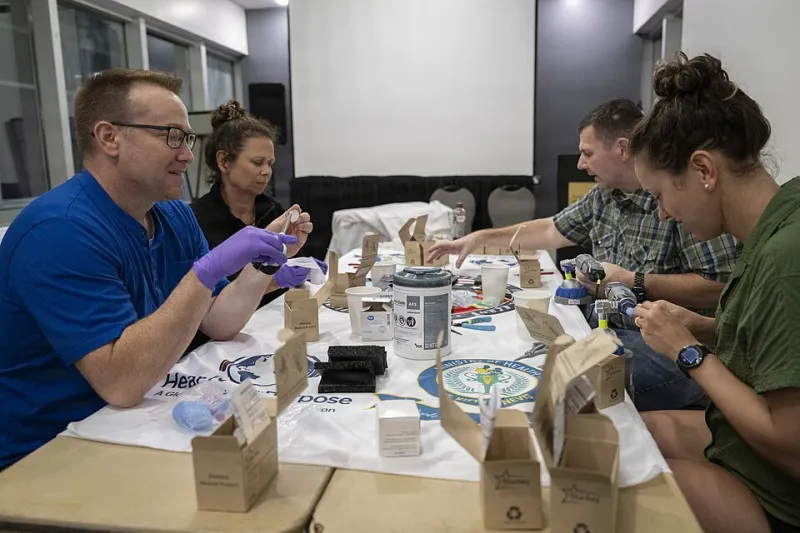
Photo: U.S. Air Force photo by Andrea Jenkins, Public domain, via Wikimedia Commons
There is a quiet moment that audiologists hear about again and again. A patient returns for a follow-up appointment somewhere around the ten- or twelve-week mark, and something has shifted. Conversations that once required intense concentration now feel almost effortless. Background noise, once overwhelming, has become manageable. Voices on the telephone sound familiar again. The patient is not sure exactly when it happened, but something clicked.
This is not coincidence. It is neuroscience.
For the millions of Americans who begin wearing hearing aids each year, the expectation is often that better hearing will arrive immediately—like putting on a pair of glasses and suddenly seeing the world in sharp focus. In reality, the auditory system does not work that way. Understanding why can make the difference between abandoning a device prematurely and reaching a level of hearing performance that genuinely changes daily life.
The Brain, Not Just the Ear, Does the Heavy Lifting
Modern hearing aids are sophisticated instruments. They process sound in milliseconds, filter competing noise, and deliver amplified audio with remarkable precision. But the technology can only do so much. The organ that ultimately determines whether that sound is useful, intelligible, and comfortable is the brain.
When hearing loss develops gradually over years—as it does for the majority of adults in the United States—the auditory cortex quietly adapts to receiving diminished input. Neural pathways that once processed the full spectrum of sound become less active. The brain, in its efficiency, reallocates some of that processing capacity to other tasks.
Introduce a hearing aid, and the auditory cortex is suddenly flooded with signals it has not encountered in years. High-frequency consonants, ambient room sounds, the rustle of clothing, the hum of an HVAC system—all of it arrives at once. The brain does not recognize this as "better hearing" immediately. It registers it as an unfamiliar, often fatiguing, sensory experience.
This is why the first weeks of hearing aid use can feel counterintuitive. The devices are working exactly as designed. The brain simply has not yet caught up.
What to Expect in the First Thirty Days
The opening month of hearing aid use is best understood as an orientation phase. Your auditory system is re-encountering sounds it may not have processed clearly in a decade or more. This period is characterized by:
- Heightened awareness of ambient noise. Sounds that others filter automatically—refrigerator hum, keyboard clicks, footsteps on hardwood—may seem startlingly loud.
- Listening fatigue. The brain is working harder than usual to process new input. End-of-day exhaustion is common and entirely normal.
- Inconsistent clarity. Some listening environments will feel dramatically improved while others remain challenging. This unevenness is expected.
- Mild discomfort with your own voice. The phenomenon known as occlusion—where your own voice sounds hollow or amplified inside your head—is a frequent early complaint that typically resolves with time and, if necessary, minor fitting adjustments.
The goal in month one is not perfection. It is consistent wear. Most audiologists recommend building up to full-day use gradually, logging listening experiences, and maintaining open communication with your hearing care provider about what is and is not working.
The Critical Middle Period: Weeks Five Through Eight
By the second month, many wearers report that the novelty of background noise has begun to fade. This is a meaningful neurological signal. The brain is beginning to re-establish its hierarchy of auditory priorities—learning, once again, to push irrelevant sounds to the perceptual background and elevate speech and meaningful audio to the foreground.
This period is also when fine-tuning appointments become especially valuable. Audiologists can adjust gain levels, directional microphone settings, and program configurations based on real-world feedback from the wearer. The information gathered during these weeks is far more useful than initial fitting data alone, because the patient now has genuine lived experience to report.
It is also worth noting that this middle phase is when dropout rates tend to spike. Wearers who expected immediate transformation may grow discouraged. Those who understand that the auditory cortex is still actively reorganizing its response to amplified sound are far more likely to persist through to the breakthrough that follows.
Month Three: Where the Science Meets the Lived Experience
Research into auditory acclimatization consistently points to the eight-to-twelve-week window as a period of meaningful perceptual shift. Studies examining speech intelligibility scores in new hearing aid users have found measurable improvements at the three-month mark that were not present at initial fitting—even when the devices themselves remained unchanged.
What is happening neurologically is a process sometimes described as cortical reorganization. The auditory cortex is rebuilding the neural infrastructure for processing a fuller range of sound. Synaptic connections that were underutilized during years of hearing loss are being reactivated and strengthened through consistent stimulation.
For the wearer, this reorganization manifests as the kind of moment that audiologists find so rewarding to witness: the patient who suddenly realizes they have been following a dinner conversation without leaning forward, or the person who hears a grandchild's voice clearly for the first time in years.
These are not random occurrences. They are the predictable outcome of a brain that has been given sufficient time and consistent input to adapt.
Months Four Through Six: Consolidation and Refinement
The final phase of the foundational adjustment period involves consolidating the gains made during the earlier weeks and refining the listening experience through continued use and professional support. By this stage, most wearers have:
- Developed intuitive habits around device management, including charging, cleaning, and program switching.
- Identified the listening environments where they want additional support—perhaps a second program optimized for restaurants or outdoor settings.
- Built enough experience to have a detailed, productive conversation with their audiologist about remaining challenges.
It is also during this period that many wearers begin exploring the fuller feature set of their devices. Bluetooth streaming, smartphone app controls, and directional hearing programs that seemed overwhelming at the outset often become genuinely useful tools once the fundamentals of amplified hearing have been internalized.
Practical Strategies for Navigating the Plateau
Knowing that a plateau exists does not make it effortless to endure. Several approaches can support the process:
Keep a listening journal. Brief daily notes about what sounded better, what remained difficult, and how fatiguing the day felt give your audiologist actionable data and give you a record of progress that can be easy to overlook in the moment.
Prioritize high-value listening environments. Rather than testing your devices in the most challenging acoustic settings first, build confidence in quieter, more controlled environments before graduating to noisier situations.
Attend all scheduled follow-up appointments. The temptation to skip a follow-up when things seem "good enough" is understandable, but fine-tuning during the adaptation window can accelerate progress significantly.
Communicate openly with your audiologist. There is no such thing as a complaint that is too minor to mention. Discomfort, inconsistency, and confusion are all data points that a skilled hearing care professional can address.
The Longer View
Hearing aids are not passive devices. They are tools that work in active partnership with one of the most complex organs in the human body. The technology that goes into modern hearing instruments is extraordinary—but it operates within a biological system that has its own timeline for adaptation.
For most new wearers, that timeline peaks somewhere around the third month. The frustration of the early weeks, the incremental improvements of the middle period, and the consolidation of the later phase are all part of a single coherent process—one that, when seen through to completion, delivers results that no amount of immediate gratification could replicate.
Patience, in this context, is not passive waiting. It is an active investment in the neurological infrastructure of better hearing. And for those who make it, the return is considerable.