5 Hearing Aid Misconceptions That Are Keeping You From Clearer Sound
Despite remarkable advances in hearing technology over the past decade, a significant gap remains between the number of Americans who could benefit from hearing aids and those who actually use them. According to the Hearing Loss Association of America, only about one in five people who need hearing aids actually wear them. Behind that statistic lies a collection of stubborn myths—beliefs shaped by outdated experiences, cultural stigma, and simple lack of information.
If you or someone you care about has been hesitant to explore hearing solutions, it is worth examining whether one of these misconceptions is standing in the way.
Myth 1: Hearing Aids Make Everything Sound Robotic and Unnatural
The Reality: This concern is rooted in the hearing aids of earlier generations—devices that amplified all sound indiscriminately, producing a tinny or mechanical quality that many users found jarring. Today's technology operates on an entirely different level.
Contemporary hearing aids use sophisticated digital signal processing to analyze incoming sound dozens of thousands of times per second. Rather than simply turning up the volume, they differentiate between speech and background noise, selectively enhancing the frequencies most important for understanding conversation while suppressing disruptive ambient sounds. Many current models incorporate machine learning algorithms that adapt to a user's specific acoustic environment in real time.
Users who have made the transition to modern hearing devices frequently describe the experience as surprisingly natural. The adjustment period exists—any new auditory experience requires some neural adaptation—but the robotic quality that defined older analog devices is largely a thing of the past.
Myth 2: Hearing Aids Are Only for People With Severe Hearing Loss
The Reality: Hearing loss exists on a spectrum, and so does hearing aid technology. Devices are available and clinically appropriate for individuals with mild, moderate, and severe hearing impairment alike.
In fact, audiologists and hearing health professionals frequently emphasize that earlier intervention tends to produce better outcomes. Waiting until hearing loss becomes severe before seeking treatment means years of increased cognitive strain, social withdrawal, and missed acoustic detail. Addressing mild to moderate hearing difficulty proactively allows the brain's auditory pathways to remain engaged and reduces the cumulative burden of straining to hear.
If you have noticed that you regularly ask people to repeat themselves, struggle to follow conversations in noisy restaurants, or find yourself turning up the television volume more than you used to, a hearing evaluation is warranted—regardless of whether you would characterize your hearing loss as significant.
Myth 3: Modern Hearing Aids Are Too Conspicuous
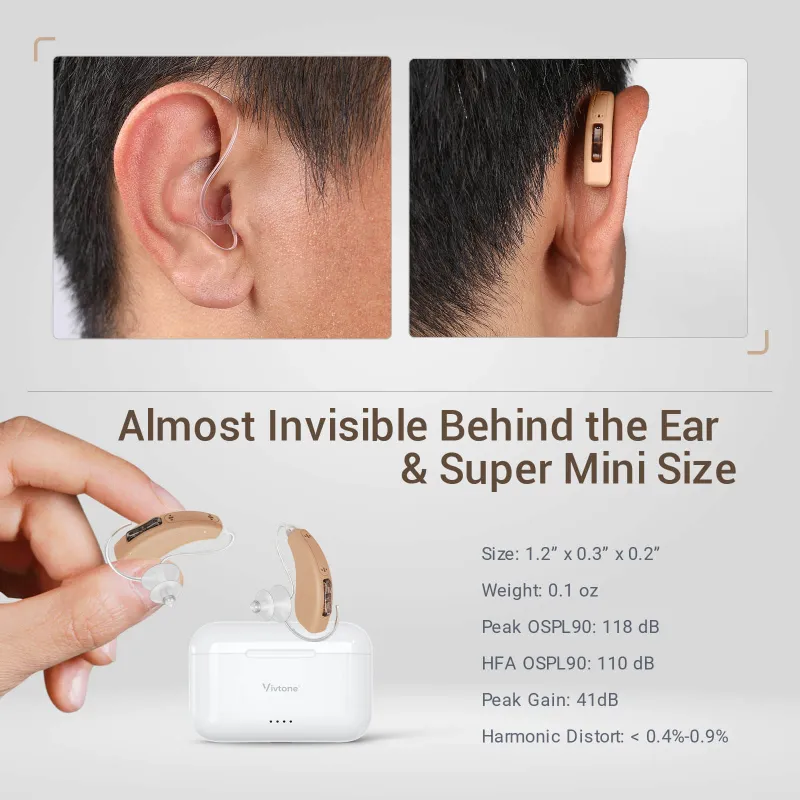
The Reality: The bulky, beige devices of decades past bear almost no resemblance to the sleek, discreet instruments available today. The hearing aid industry has invested heavily in miniaturization and aesthetic design, producing devices that many wearers find virtually invisible in everyday use.
Receiver-in-canal (RIC) styles, for example, feature a tiny housing that sits behind the ear connected by a near-invisible wire to a small speaker positioned directly in the ear canal. Completely-in-canal (CIC) and invisible-in-canal (IIC) models are custom-fitted to sit entirely within the ear canal, making them imperceptible to most observers.
Beyond size, modern hearing aids have shed the stigmatized appearance of medical devices. Many now resemble wireless earbuds—a form factor that has become so commonplace in American culture that wearing ear technology carries no social weight whatsoever. Some manufacturers have leaned into this aesthetic deliberately, producing devices that look at home alongside consumer electronics rather than clinical equipment.
Myth 4: Hearing Aids Are Prohibitively Expensive
The Reality: Cost is a legitimate consideration, and it would be disingenuous to suggest that hearing aids are inexpensive. However, the financial landscape has shifted considerably in recent years, and the range of available options is broader than many people realize.
A significant development occurred in 2022 when the U.S. Food and Drug Administration established a new category of over-the-counter (OTC) hearing aids for adults with mild to moderate hearing loss. These devices are available without a prescription at major retailers and online, with many models priced between $200 and $1,500—a dramatic reduction compared to the $3,000 to $7,000 range often associated with prescription devices.
For those who require prescription-level technology, insurance coverage has also improved. Several major insurers now offer partial or full coverage for hearing aids, and Medicare Advantage plans frequently include hearing benefits. Flexible spending accounts (FSAs) and health savings accounts (HSAs) can also be applied toward hearing device purchases. Financing options through hearing care providers make higher-tier devices accessible through manageable monthly payments.
When evaluating cost, it is also worth considering the expense of not treating hearing loss—in terms of reduced quality of life, strained relationships, and the growing body of research linking untreated hearing impairment to costly long-term health consequences.
Myth 5: Once You Get a Hearing Aid, You're Committed to Wearing It Forever
The Reality: This misconception may stem from a fear of dependency or a reluctance to accept a permanent change to one's daily routine. The truth is more straightforward: hearing aids are tools, not irreversible commitments.
Most hearing care providers offer trial periods—commonly 30 to 60 days—during which users can assess whether a device meets their needs before finalizing a purchase. Hearing needs also evolve over time, and audiologists routinely adjust device programming as a patient's hearing profile changes. Switching devices, upgrading technology, or pausing use is entirely within a user's control.
What the evidence does suggest, however, is that consistent use produces better outcomes. The brain adapts to amplified sound gradually, and sporadic use can slow that adaptation. Most users who give themselves adequate time to adjust report meaningful improvements in communication, confidence, and overall quality of life.
Moving Past the Myths
The decision to explore hearing technology is deeply personal, and it deserves to be made on the basis of accurate, current information rather than outdated assumptions. Modern hearing aids are smaller, smarter, more natural-sounding, and more financially accessible than at any previous point in their history.
At Ear Machine, our purpose is to ensure that no one delays better hearing because of a misconception that no longer holds true. If any of the myths above have shaped your thinking, we encourage you to take the next step: consult with a qualified hearing care professional and discover what today's technology can actually offer.