Remarkable Devices, Reluctant Adopters: Why Millions of Americans Still Aren't Using Modern Hearing Aids
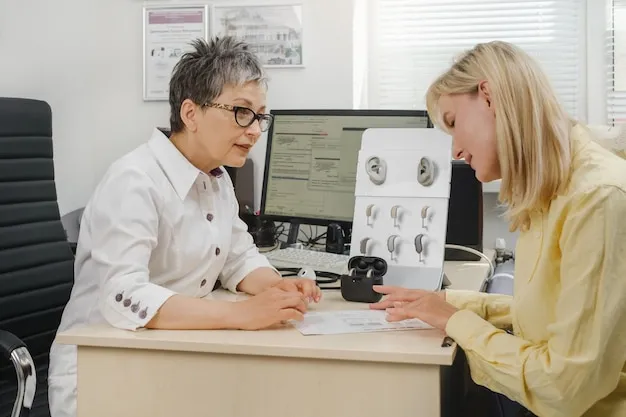
Photo: audiologist consulting patient about hearing aids in clinical office, via img.freepik.com
By almost any measure, hearing aid technology has entered a golden era. Devices that once resembled clunky beige shells now sit nearly invisible within the ear canal, process sound through artificial intelligence, stream audio directly from smartphones, and recharge overnight like a wireless headphone. For those who manufacture and study these instruments, the progress has been extraordinary.
And yet, a stubborn and troubling reality persists: approximately 38 million Americans live with clinically significant hearing loss, and fewer than one in three of them currently uses a hearing aid. Among adults aged 70 and older—the demographic most likely to experience meaningful hearing decline—adoption rates hover around 30 percent, according to data from the National Institute on Deafness and Other Communication Disorders. The technology has advanced. The treatment gap has not closed.
This contradiction sits at the heart of one of American auditory health's most pressing dilemmas. Why, precisely at the moment when hearing devices have become more capable, more discreet, and more connected than ever before, do millions of people who would genuinely benefit from them continue to go without?
The Price Barrier Remains Formidable
For many Americans, the conversation begins and ends with cost. A pair of prescription hearing aids from an audiologist can range from $3,000 to well over $7,000—a figure that includes professional fitting, follow-up care, and ongoing adjustments, but that still represents a significant financial burden for households on fixed incomes or without robust insurance coverage.
Medicare, the primary insurer for Americans over 65, has historically excluded hearing aids from its standard benefits. While the Inflation Reduction Act and ongoing legislative discussions have brought renewed attention to this gap, coverage remains inconsistent and incomplete across the country. Medicaid policies vary dramatically by state. Most private insurance plans treat hearing aids as elective or ancillary, covering little or nothing.
The 2022 introduction of over-the-counter (OTC) hearing aids—a category now regulated by the FDA for adults with perceived mild to moderate hearing loss—was widely heralded as a democratizing development. Devices are now available at major retailers for a few hundred dollars. While this represents genuine progress, audiologists and hearing health advocates caution that OTC devices are not appropriate for all levels of hearing loss and that the absence of professional guidance can lead to poorly fitted, underperforming instruments that ultimately discourage continued use.
Cost, in other words, has become more navigable for some Americans—but the financial obstacle remains real and consequential for many others.
The Long Road From Awareness to Action
Even when cost is not the primary deterrent, a separate and equally significant barrier emerges: the time between when a person first notices hearing difficulty and when they seek professional evaluation is, on average, seven to ten years.
That delay is not simply procrastination. Hearing loss typically progresses gradually, and the brain is remarkably adept at compensating for early deficits—leaning on visual cues, context, and familiarity to fill in what the ears miss. Many people genuinely do not recognize the extent of their impairment until it becomes severe enough to affect daily functioning in obvious ways.
But research also points to a psychological dimension that technology cannot easily address. For a significant portion of the population, accepting a hearing aid carries an implicit acknowledgment of aging, vulnerability, or disability—associations that many individuals find deeply uncomfortable. Studies have consistently shown that self-perception plays a meaningful role in treatment decisions, with some patients reporting that they would rather struggle to hear than signal to others that their hearing has declined.
This psychological resistance is not irrational. It reflects genuine social pressures and cultural attitudes around aging and physical limitation. Addressing it requires more than engineering a better device; it requires shifting how hearing health is perceived and discussed at a societal level.
Accessibility Beyond the Price Tag
Geography adds another layer of complexity. Access to licensed audiologists and hearing instrument specialists is not uniformly distributed across the United States. Rural communities, in particular, often face significant shortages of auditory health professionals. For a patient in a metropolitan area, scheduling a comprehensive hearing evaluation may be straightforward. For someone in a rural county with limited transportation options, the same process can involve hours of travel and extended wait times.
Telehealth has begun to address some of these disparities, with remote hearing assessments and virtual follow-up appointments becoming more common in the wake of the COVID-19 pandemic. Certain hearing aid manufacturers have also introduced remote fine-tuning capabilities, allowing audiologists to adjust device programming through a smartphone app without requiring an in-person visit. These are meaningful developments—but they remain underutilized and unevenly available.
What Happens When Hearing Aids Disappoint
Perhaps the most underappreciated contributor to the treatment gap is the experience of patients who do obtain hearing aids and subsequently abandon them. Industry estimates suggest that between 15 and 24 percent of hearing aid owners stop wearing their devices within the first few years—a rate that reflects unmet expectations as much as anything else.
Modern hearing aids are genuinely impressive instruments, but they are not perfect surrogates for natural hearing. Background noise in restaurants, telephone conversations, and large gatherings can still present challenges, even with advanced directional microphones and AI-driven noise suppression. When a patient invests thousands of dollars expecting to hear as they did at 30 and instead finds that some situations remain difficult, disappointment can lead to abandonment—and, critically, to discouraging word-of-mouth that shapes the decisions of others.
Managing patient expectations through thorough counseling, realistic goal-setting, and consistent follow-up care is considered essential by audiologists, yet time constraints and insurance reimbursement structures do not always support the depth of engagement that produces the best outcomes.
Closing the Gap Requires More Than Innovation
The hearing aid industry's engineering achievements over the past two decades are genuinely remarkable. Devices that connect seamlessly to digital ecosystems, adapt in real time to acoustic environments, and fit so discreetly as to be nearly undetectable represent a profound leap from the analog instruments of a generation ago.
But the persistent treatment gap reveals that technological excellence, on its own, is insufficient. Closing the distance between what is possible and what patients actually experience will require parallel progress on multiple fronts: expanded insurance coverage, continued investment in telehealth and rural access, sustained public health campaigns that destigmatize hearing loss, and a clinical culture that prioritizes long-term patient engagement alongside device fitting.
For the millions of Americans currently navigating the world without the hearing support they need, the most sophisticated ear machine ever built is of limited value if it remains out of reach—financially, geographically, or psychologically. The devices exist. The harder work of ensuring that people actually use them is only beginning.